NDIS guides
Registered vs Unregistered NDIS Providers: What's the Real Difference?

This comes up in almost every first conversation we have with a new family comparing NDIS service providers: "Do you need to be registered?" It's a fair question, and the short answer is — it depends on how your plan is managed, not on which provider is "better."
In short
Registered NDIS providers have been audited against the relevant NDIS Practice Standards and can provide the supports covered by their registration. Unregistered providers haven't gone through NDIS registration, but can still provide certain supports to self-managed and plan-managed participants. Your plan management type — not provider quality — is what decides which ones are available to you.
On this page
What does "registered" actually mean?
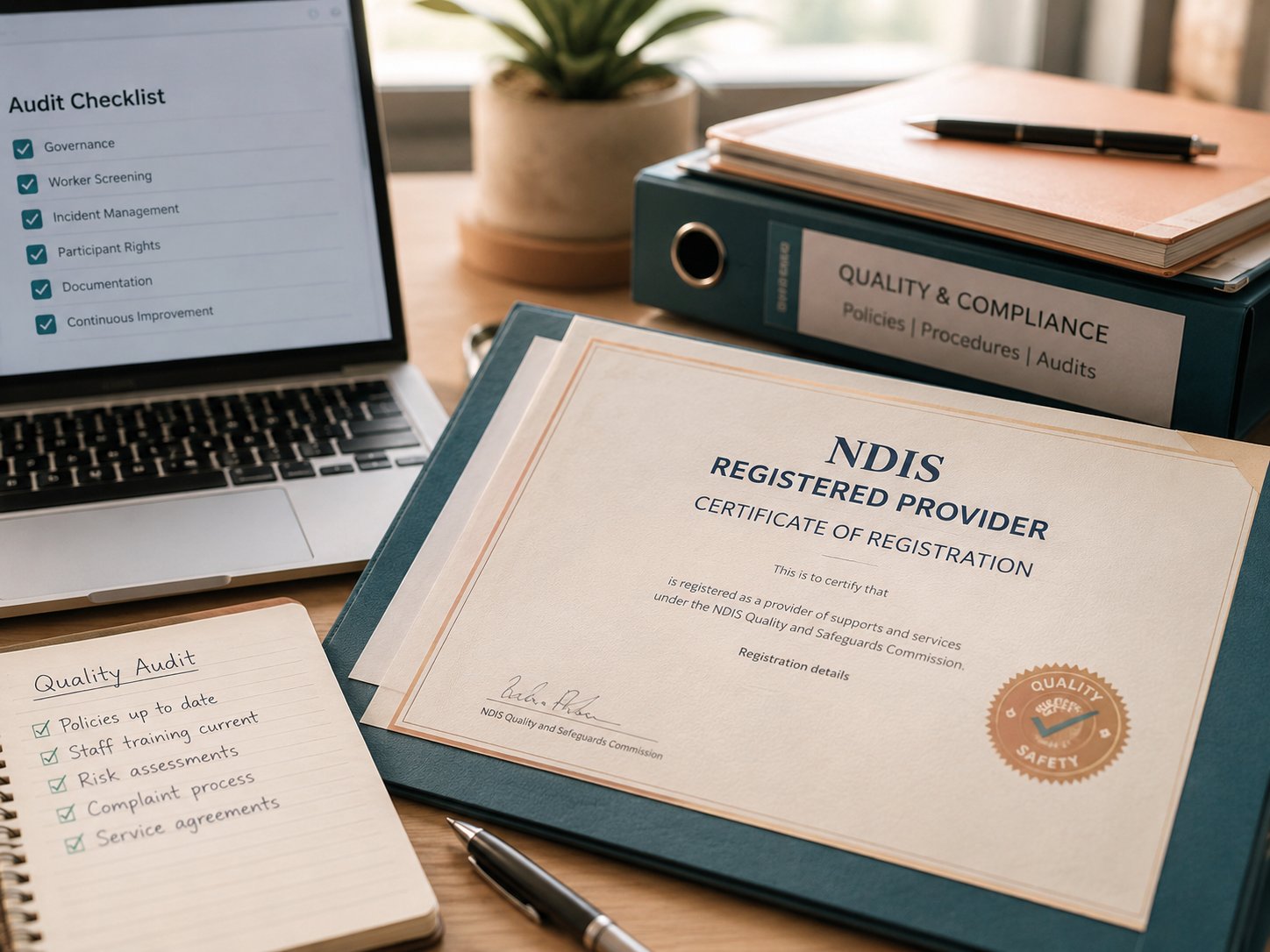
Getting registered isn't a quick form-fill. A provider has to go through an independent quality audit, carried out by an approved auditor, that checks them against the NDIS Practice Standards relevant to what they actually deliver — governance, how they protect participant rights, how they manage complaints and incidents, and more, depending on their registration scope. The NDIS Commission then reviews the application and the provider's overall suitability before granting registration. And it doesn't stop there: registration comes with ongoing conditions, and depending on scope, further audits during the registration period.
Registration also depends on the supports provided
A provider's registration covers specific support types and services. Being a registered NDIS provider doesn't automatically mean they're registered to deliver every type of NDIS support. If the type of support you need is important to your choice, it's worth checking the provider's registration details rather than assuming registration covers everything.
What does "unregistered" actually mean?
An unregistered provider hasn't gone through the NDIS registration process. That doesn't, by itself, tell you whether the provider is suitable for your needs — it just means the checking sits with you rather than with an audit.
If you choose an unregistered provider, it's particularly worth checking their experience, worker screening, service agreement, pricing and complaints process before starting support.
| What you're comparing | Registered | Unregistered |
|---|---|---|
| NDIS registration | Yes | No |
| Can generally be used with NDIA-managed funding | Yes | No |
| Can be used by plan-managed participants | Yes | Yes |
| Can be used by self-managed participants | Yes | Yes |
| NDIS pricing limits | Apply where applicable | Depends on how funding is managed |
| NDIS registration audit | Yes | No |
Who can actually use which one
This is the part that actually decides things — not preference, but plan type.
- NDIA-managed — you generally need to use registered NDIS providers.
- Plan-managed — you can use either registered or unregistered providers.
- Self-managed — same as plan-managed, you have the choice of both.
If you're not sure which category you fall into, it's on your plan document, or your Local Area Coordinator can confirm it in a couple of minutes. Check this before you get attached to a provider who turns out not to be an option.
These rules apply regardless of which Melbourne suburb you live in, including Tarneit — your plan management type determines which provider options are available to you. Our guide to NDIA-managed, plan-managed and self-managed plans goes into how each arrangement works.
Does registration actually affect quality?
Not directly. Registration means a provider has met the relevant registration requirements and is subject to ongoing registration conditions and applicable audit requirements. People often mistake that for a guarantee of quality, but it isn't one. It doesn't tell you whether their support workers turn up on time, whether you'll see the same face each visit, or whether they actually listen when you explain what you need.
Registration provides an important level of regulatory oversight, but it doesn't guarantee that a provider will be the right fit for every participant. If you're choosing between two registered providers, or between a registered and unregistered one, the questions that actually separate a good fit from a bad one are things like communication, consistency of support workers, and clear pricing — the same things we cover in our guide to choosing an NDIS provider in Melbourne.
Worth remembering
Registration helps determine whether a provider can be used with your type of NDIS funding, and whether they're registered for the supports you need. It doesn't tell you whether they'll actually work well for you — that's a separate question, worth treating as one.
How to decide what's right for you
- Check your plan type first. If you're NDIA-managed, this decision is already made for you — registered only.
- If you have a choice, weigh it up properly. Registered providers are subject to NDIS registration requirements, Practice Standards and applicable audit and compliance obligations. Compare pricing, availability, service agreement and approach to support rather than assuming one registration status is automatically better for you.
- Don't assume either option is automatically safer. Ask for references and check in on how a provider actually operates, regardless of registration status.
- Get the price and terms in writing either way. Applicable NDIS pricing limits depend on your funding arrangement and the support you're purchasing — confirm the agreed rate and any additional charges before starting.

Key takeaways
- Registration means a provider has passed an independent audit against the NDIS Practice Standards for their scope — not that they're better than an unregistered one.
- Your plan management type decides your options: NDIA-managed means registered only; plan-managed and self-managed can use either.
- A provider's registration covers specific support types, so check they're registered for the support you actually need.
- Registration is regulatory oversight, not a guarantee of fit. Communication, worker consistency and clear pricing tell you more.
- Whichever type you choose, get the rate, travel policy and cancellation terms in writing before support starts.
About Sahima Care Services
Still working out what's right for your plan?
Sahima Care Services is one of the registered NDIS providers in Truganina, covering Melbourne's western suburbs. We're happy to talk through what fits your situation — including whether registration status actually matters for the support you're after.
See How We Support ParticipantsCommon questions
What is an unregistered NDIS provider?
An unregistered NDIS provider is a provider that has not gone through the NDIS registration process. Unregistered providers can still deliver many types of support, but generally only to participants who are self-managed or plan-managed, subject to the applicable NDIS rules.
What is a registered NDIS provider?
A registered NDIS provider has gone through the NDIS registration process and met the requirements for the support and services covered by their registration. Registered providers may work with participants across all three funding arrangements: NDIA-managed, plan-managed and self-managed.
Can I use an unregistered NDIS provider?
Yes, if your funding is self-managed or plan-managed and the support you need can be provided by an unregistered provider. If your plan is NDIA-managed, you generally need to use a registered NDIS provider.
Is an unregistered NDIS provider safe to use?
Registration status alone does not determine whether a provider is right for you. Look at their experience, worker screening and training, service agreement, pricing, insurance and complaints process before deciding whether they are suitable for your support needs.
Do registered NDIS providers cost more?
Not necessarily. The cost depends on the support being provided, your funding management type, the provider and the applicable NDIS pricing arrangements and price limits.
Which is better, registered or unregistered?
Neither is automatically better. The right choice depends on how your NDIS funding is managed, the type of support you need, the providers available to you and what matters most to you when choosing a provider.
In summary
Registered or unregistered is rarely the question that actually matters. Check how your plan is managed — that settles what's available to you — then judge providers on the things that affect your week: whether they communicate clearly, whether you'll see the same support worker, and whether the pricing is upfront. Registration is a floor, not a ranking.
For official detail on provider registration, see the NDIS Quality and Safeguards Commission.