NDIS guides
NDIS Cleaning vs Regular House Cleaning: A Guide to the Difference
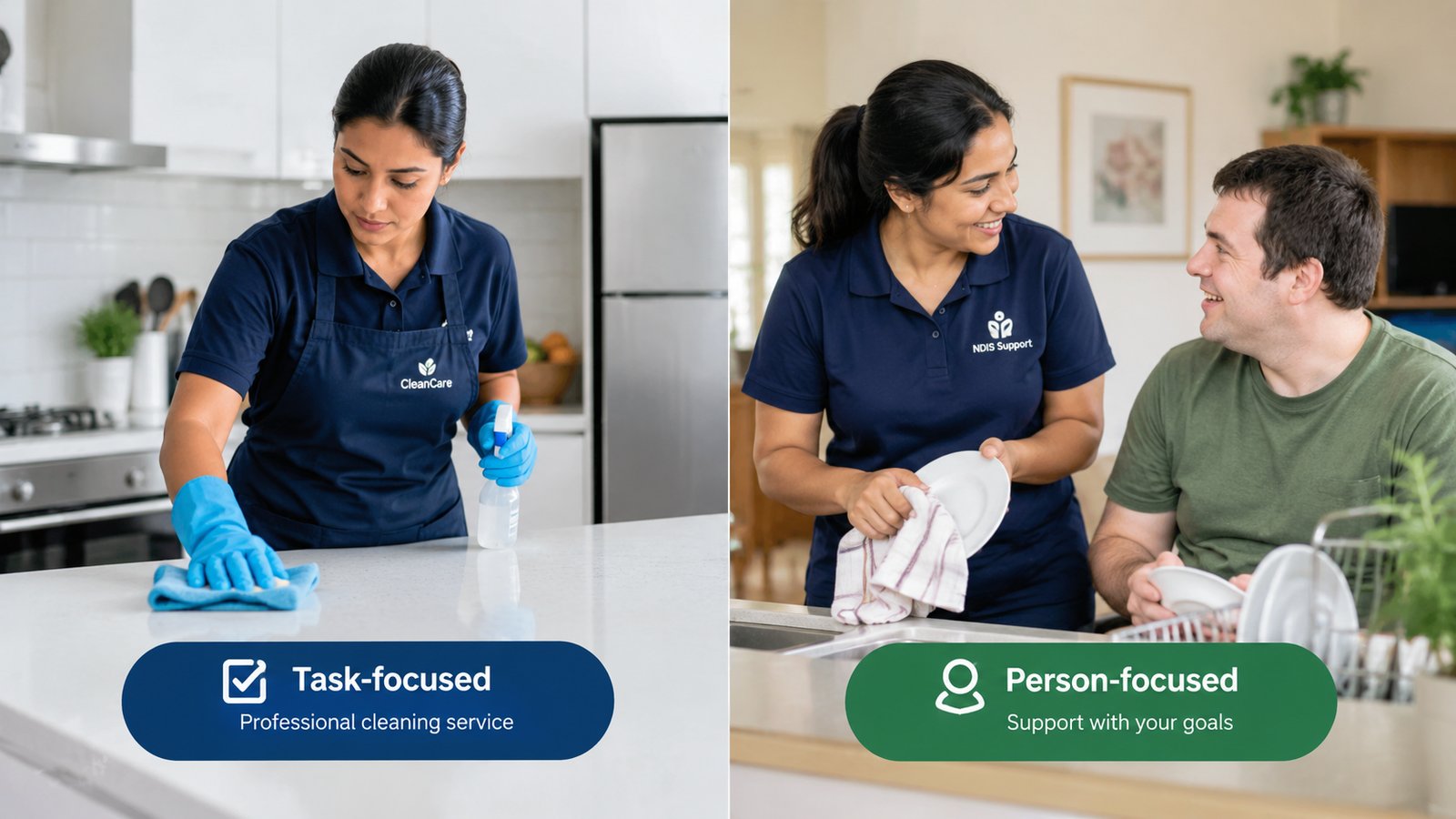
In short
NDIS cleaning and regular house cleaning are not the same type of service. A regular cleaner focuses on completing a cleaning job, while NDIS household task support addresses a participant's disability-related needs. The support is generally charged by the hour and can include cleaning, laundry and other household tasks — but whether NDIS funding applies depends on your plan and its disability-related purpose.
On this page
The difference isn't the cleaning — it's the purpose
A commercial cleaner is paid to produce a clean house. Success is measured by the state of the house at the end.
An NDIS support worker delivering household tasks is paid to support a participant, whether they work for us — an NDIS registered provider in Melbourne — or elsewhere. A clean house is usually the outcome, but it is not the whole point. The point is that a disability-related barrier is being addressed — which may mean working alongside you, adapting to a bad day, or slowly building the capacity to do more yourself. A regular cleaner will usually work to an agreed cleaning scope, while a support worker may adjust household tasks around the participant's needs and capacity on the day. Some providers describe their workers as domestic support workers to make that broader scope explicit, to distinguish them from NDIS cleaners who focus on the clean itself.
That distinction sounds abstract until you see what it means on a difficult day. A support worker notices you are not doing well, adjusts the plan, and may spend the time on the two things that will make the week manageable rather than working through a checklist. Our own NDIS household task support in Melbourne works this second way.

Side by side
| What you're comparing | Regular house cleaner | NDIS household task support |
|---|---|---|
| Primary purpose | Clean the house | Support a participant with a disability-related need |
| Pricing | Often a flat job or package price | Hourly, at or below the NDIS price limit |
| Scope | Fixed and defined up front | Flexible within your agreement |
| Training | Cleaning technique | Disability support, plus NDIS Worker Screening and the Worker Orientation Module |
| Adapts to your day | Rarely | Expected |
| Can build your capacity | No | Yes, where that's a plan goal |
| Deep-clean skill | Usually stronger | Usually more general |
| Regulation | General consumer law | NDIS Practice Standards and Code of Conduct (registered providers) |
How pricing works differently
This is where the two models diverge most sharply, and where misunderstandings tend to start.
A commercial cleaner may quote "$180 for a three-bedroom house" — a flat price for a defined outcome. Household task support is generally claimed under Core Supports → Assistance with Daily Life, charged hourly rather than as a flat job price. The applicable support item and current price limit can change, so check the current NDIS pricing arrangements rather than relying on a fixed figure. A 90-minute visit is billed as 1.5 hours.
Two consequences follow from that:
- You're buying time, not an outcome. If the house needs four hours of work and you have funding for two, you get two hours of work — not a compromised whole-house clean.
- Flat "per clean" pricing is a flag. Against NDIA-managed or plan-managed funding, this item is structured as hourly. If a provider quotes a flat fee, ask how they're claiming it.
Self-managed participants have more room here. You're not bound by NDIS price limits and can negotiate directly with any provider, including a regular cleaner. The support still has to relate to your plan's purpose, and you need to keep records.
For current NDIS household task funding and pricing, check with your plan manager or the NDIA, or get in touch with Sahima Care Services directly.
Which one suits which situation
Not all NDIS cleaners Melbourne participants find are the same kind of provider — some are cleaning companies, others are support workers who happen to clean. Which one suits you depends on what you actually need. If you're specifically trying to work out whether cleaning can be funded at all, see our guide to whether the NDIS pays for house cleaning. If you're deciding what a support worker can actually help with day to day, see our full breakdown of what cleaning tasks a support worker can help with.
A regular cleaner may suit if…
- You want a specific, thorough cleaning outcome and nothing else
- Your needs are stable and predictable week to week
- You're self-managed and want to choose freely on price and quality
- You have other supports covering the relational and capacity-building side
A support worker may suit if…
- Your capacity varies — some days you can do more than others
- You want help doing tasks rather than having them done for you
- Building independence at home is a goal in your plan
- You want the same person each visit, who learns how you like things
- You need someone who can flex between cleaning, laundry and meal prep depending on the day
Continuity is the thing most people underrate
When participants describe household support that has worked well over years, the reason is almost never cleaning quality. It is that the same person keeps turning up.
A consistent worker learns where things go, notices when something has changed, and does not need re-briefing every fortnight. A rotating roster means starting over each time, which erodes most of the advantage support work has over a commercial clean.
It is worth asking directly: will I get the same worker, and what happens when they're away? In Sunshine West, that continuity is exactly what our local team is built around — see our NDIS provider Sunshine West for details.

Common questions
Can a regular cleaning company become an NDIS provider?
Yes. Cleaning businesses can register with the NDIS Commission for the household tasks registration group, and many have. Registration means they meet the NDIS Practice Standards — it doesn't mean their workers have disability support training.
Is NDIS cleaning more expensive than a regular cleaner?
The hourly rate is often higher than a domestic cleaner's, because it reflects a support worker cost model including screening, training, supervision and insurance. Whether it costs you more depends on your plan management — for NDIA-managed and plan-managed participants, the funding covers it up to the price limit.
Can I use both an NDIS support worker and a regular cleaner?
Yes, and some people do — a support worker for regular household tasks, and a commercial cleaner privately for periodic deep cleans. Whether the second one can be claimed depends on your plan and how it's managed.
Do NDIS support workers get police checks?
Workers in risk-assessed roles with registered providers require NDIS Worker Screening clearance, and must complete the NDIS Worker Orientation Module. Requirements differ for unregistered providers, so it's worth asking directly.
Sources and further reading
- NDIA, NDIS Pricing Schedule 2026-27 — item 01_020_0120_1_1
- NDIS Quality and Safeguards Commission, NDIS Worker Screening and NDIS Code of Conduct
Pricing figures reflect the NDIS Pricing Schedule 2026-27, effective 1 July 2026. Price limits are reviewed each July — confirm the current figure on ndis.gov.au before relying on it.