NDIS guides
What Are Household Tasks Under the NDIS?
In short
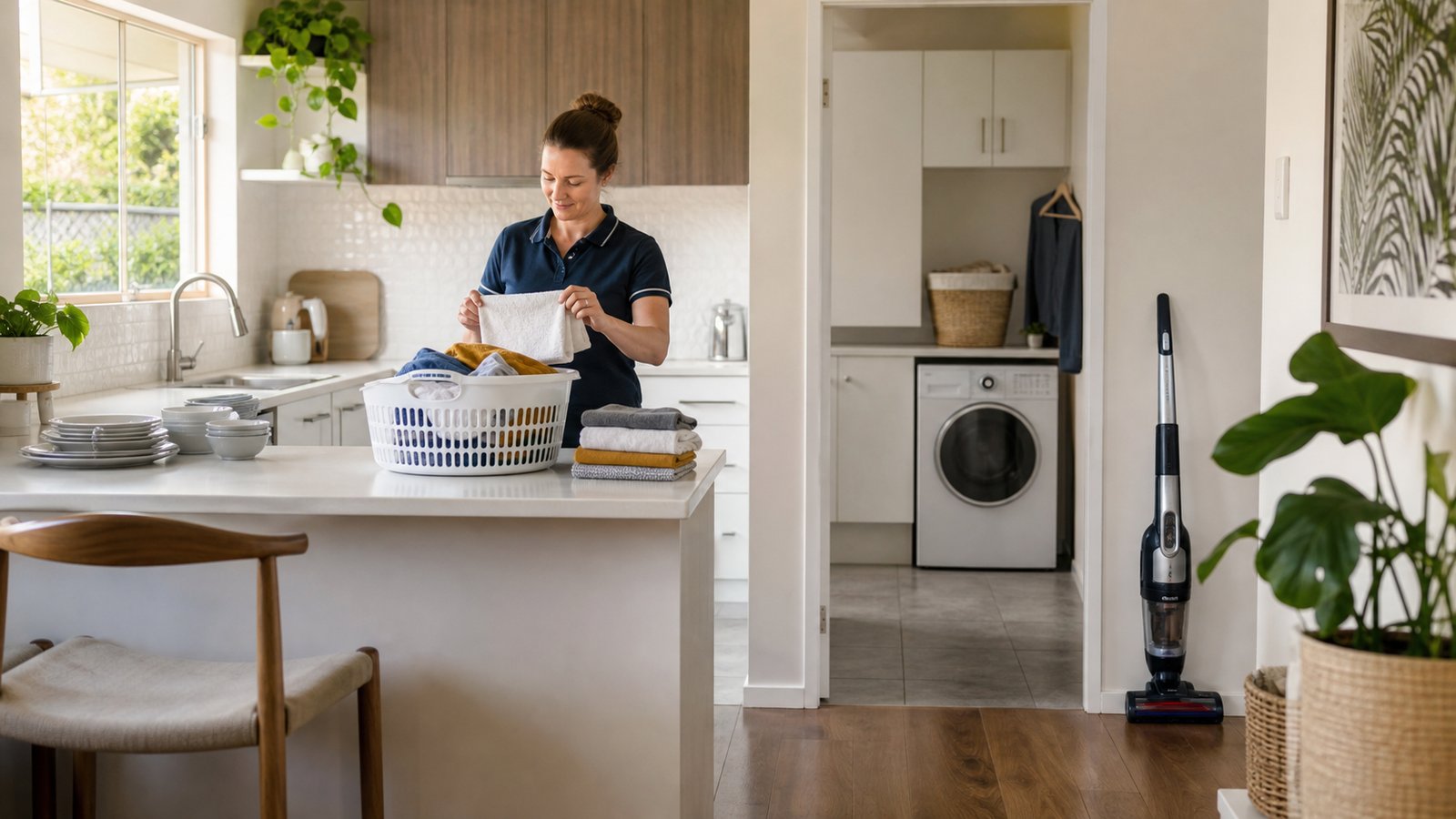
Under the NDIS, household tasks are supports that help participants with essential household activities they are unable to undertake because of their disability. Household Tasks is NDIS registration group 0120 and covers supports such as cleaning, laundry and other essential household activities. What you can use your funding for depends on your plan and the NDIS rules that apply to you.
On this page
The NDIS uses "household tasks" as a formal category
This is not a loose descriptive phrase. "Household Tasks" is registration group 0120 in the NDIS system — one of the categories a provider registers against, and the term you will see on the NDIS Provider Finder when searching for this kind of support. In plainer language, it's help with the daily household chores that have become difficult or unsafe because of your disability.
The terminology matters when you're looking for a registered provider or checking which type of support applies to your plan.
Household tasks are generally associated with Assistance with Daily Life and may be funded through the relevant NDIS budget in a participant's plan. What you can use your funding for depends on your plan and the NDIS rules that apply to you. You'll also see this called NDIS domestic assistance — it isn't a different service, just different phrasing.
If you're ready to arrange it rather than read about it, our NDIS household task support in Melbourne page explains how we deliver it.
What the definition actually turns on
The NDIS description of the support item is deliberately broad: performing essential household activities that a participant is not able to undertake themselves.
The key question is whether your disability means you are unable to undertake the household activity yourself. NDIS funding isn't simply intended for chores you would prefer someone else to do.
That distinction explains much of what confuses people about this support:
- Why two participants asking for the same task get different answers
- Why a plan might fund help with the bathroom but not the whole house
- Why the NDIA asks about functional capacity rather than about your preferences
- Why the support is framed around assistance rather than a cleaning service
In practice
When you describe your need to a planner or provider, describe the barrier, not the chore. "I can't stand long enough to do the dishes without my back giving out" lands very differently from "I need help with dishes".
How household task support is claimed
Household task support is claimed against specific NDIS support items, within the Household Tasks registration group — where the visit is cleaning-focused, some providers describe this as NDIS cleaning support. Exact item numbers and price limits are reviewed by the NDIA and can change, so check the current NDIS Support Catalogue and Pricing Arrangements rather than relying on a specific code you've seen elsewhere.
When checking an invoice, make sure the support type, date, hours and amount match the services you actually received.
What household tasks can the NDIS help with?
Depending on the participant's disability-related needs and NDIS funding, household task support — sometimes called home help care services — may include:
- House cleaning — see does the NDIS pay for house cleaning?
- Laundry
- Changing and washing bedding
- Dishwashing
- Vacuuming and mopping
- Dusting
- Basic household tidying
- Meal preparation
- Some eligible yard or household maintenance tasks, sometimes delivered as NDIS gardening services
The specific tasks available depend on your individual needs, plan and the applicable NDIS rules.

What household tasks don't usually cover
NDIS household task funding isn't simply a general cleaning allowance. The support must relate to a disability-related need and the participant's NDIS plan and funding arrangements.
- Cleaning simply because you are busy, rather than because of a disability-related need
- General household services unrelated to disability
- Tasks you can safely complete yourself
- Costs that aren't an eligible NDIS support
How the support is delivered
Household task support is commonly delivered in the participant's home and may be charged based on the relevant NDIS support item and agreed service arrangement — a form of NDIS in-home support.
Because it is generally time-based rather than outcome-based, the practical constraint is usually hours, not scope. Two hours a fortnight will not get a four-bedroom house comprehensively cleaned. Most people find their arrangement works better once they prioritise: agree the two or three things that matter most, and let the rest sit.
GST treatment depends on the type of NDIS support and whether the relevant GST-free requirements are met. Many NDIS supports are GST-free, but not all. Check your service agreement and current NDIS/ATO guidance if you're unsure whether GST applies to your support.
How it differs from the other terms you'll hear
| Term | What it means |
|---|---|
| Household tasks | The official NDIS registration group and support category |
| Domestic assistance | Everyday phrasing for the same thing — common in aged care, not an NDIS term |
| Personal domestic activities | A specific hybrid line item combining personal care and domestic help |
| Personal care | A different support — help with your body, not your home |
| NDIS cleaning | Marketing shorthand, not an NDIS category |
Providers and participants use all of these interchangeably in conversation. That is fine day to day, but when you are reading a plan, a service agreement or an invoice, the precise term matters — because it determines which budget the support is drawn from.
If you're in Werribee and ready to arrange this rather than keep reading about it, see our NDIS provider Werribee. Sahima Care Services provides practical assistance with cleaning, laundry, bedding and meal preparation.
Common questions
Is household tasks funding automatically in every NDIS plan?
No. It appears where the planning process identified a disability-related need for help at home. If your plan has Core funding for Assistance with Daily Life, you may be able to use it for household tasks — check with your plan manager or support coordinator.
Can I use household task funding for gardening?
It may cover eligible yard maintenance where the task relates to your disability-related support needs and your NDIS funding allows it. This is usually claimed under a different item to general household tasks — check with your plan manager or provider.
Does the NDIS pay for cleaning products?
Not necessarily. Whether consumables or cleaning products are covered depends on the relevant NDIS rules, your plan and the support being provided. In practice, most participants find products and equipment are treated as an ordinary cost of living, with funding covering the worker's time rather than the supplies.
What's the difference between household tasks and Supported Independent Living?
Household tasks is a discrete support delivered in your own home for agreed hours. Supported Independent Living (SIL) is a much broader arrangement covering help throughout the day in a shared living setting, and it uses an entirely different funding structure.
Sources and further reading
- NDIA, NDIS Pricing Schedule 2026-27 and NDIS Support Catalogue — registration group 0120, Household Tasks
- NDIA, Provider Finder — registration group 0120, Household Tasks
- NDIA, managing your plan — guidance on using and protecting plan funding
Pricing figures reflect the NDIS Pricing Schedule 2026-27, effective 1 July 2026. Price limits are reviewed each July — confirm the current figure on ndis.gov.au before relying on it.