NDIS guides
Will the NDIS Pay for Laundry?
In short
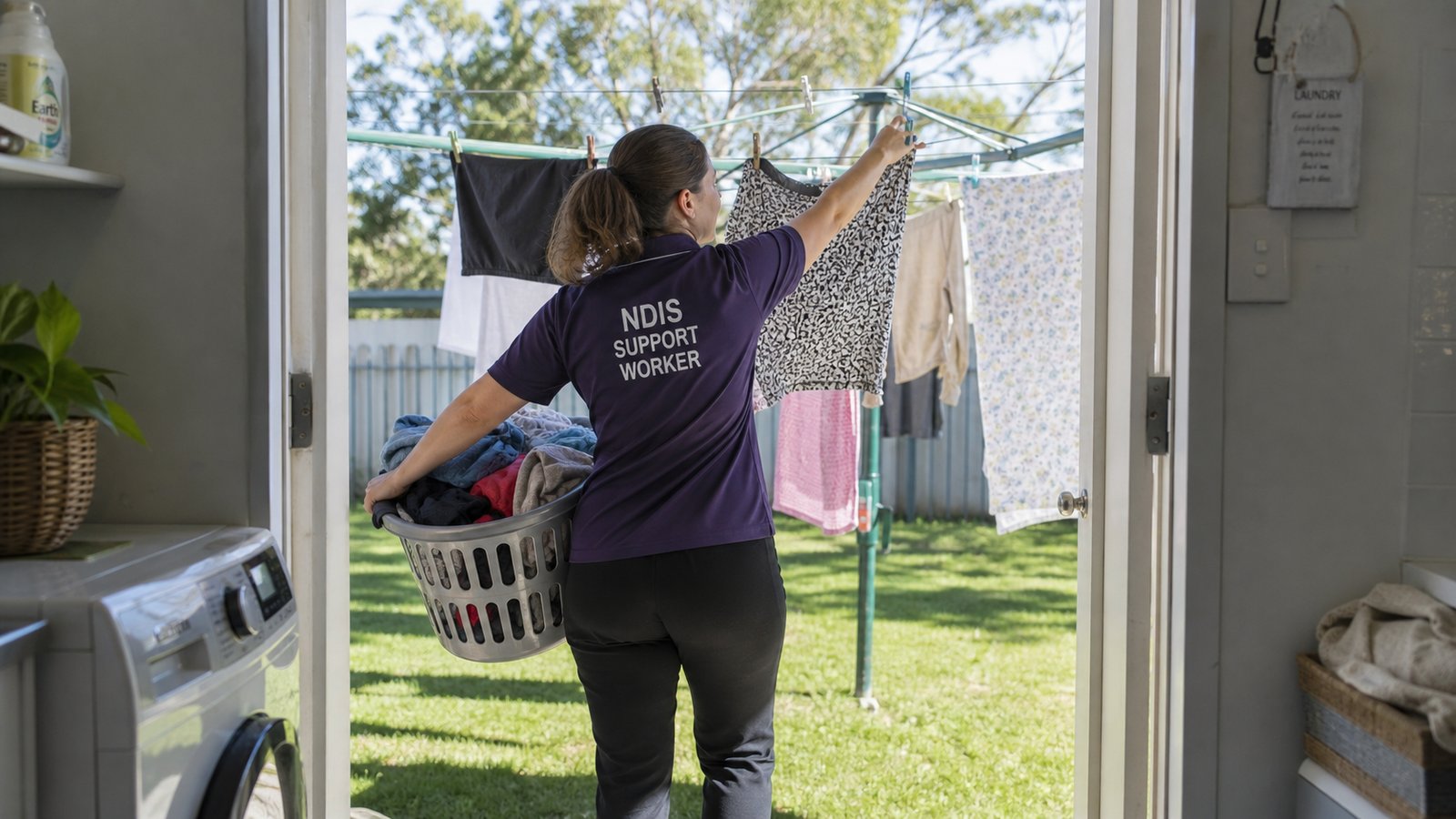
Yes — the NDIS can fund help with laundry where your disability makes it difficult or unsafe to manage yourself. Laundry assistance may be provided as part of household task support, using your Core Supports funding, where the support is reasonable and necessary. Funding relates to the support provided, not ordinary costs like detergent or buying clothes.
On this page
Why laundry can be included in NDIS household task support
Laundry involves an unusual number of physical demands stacked together: carrying a full basket, bending to load and unload, reaching to hang, standing to fold, and repeating the whole cycle. For a lot of participants it is harder than cleaning.
It is also cumulative in a way other tasks are not. Skip vacuuming for a fortnight and the floor is dusty. Skip laundry for a fortnight and you run out of clothes, which affects whether you can leave the house.
For some participants, the physical demands and frequency of laundry can make it difficult to manage without assistance. Explaining how your disability affects your ability to complete laundry can help show why the support is needed. "NDIS laundry service" or NDIS laundry services — the singular and plural are used interchangeably — is a common way people describe this type of support, but the actual support and claim depend on your NDIS plan, funding arrangements and the service you receive.
How NDIS household-task support applies to laundry. The NDIS describes household-task supports as assistance with essential household tasks that a participant is unable to undertake themselves. Laundry can therefore be relevant where a participant's disability affects their ability to manage washing, drying, folding or related household tasks.
What laundry support usually includes
Depending on your needs and service agreement, a support worker from an NDIS provider in Melbourne may help with:
- Sorting and loading the washing machine
- Hanging washing on the line or transferring it to a dryer
- Bringing washing in and folding it
- Putting clothes away in wardrobes and drawers
- Changing and washing bed linen and towels
- Ironing, where it's genuinely needed rather than preferred
- Managing laundry related to continence needs
How much of this happens depends on your hours. A wash cycle runs 45 minutes to an hour, and because washing machines have that waiting time built in, you can often discuss sequencing laundry with other agreed household tasks during the same visit. Our NDIS household task support in Melbourne is built around exactly that kind of sequencing, and covers the same broad range of tasks discussed in our guide to what household tasks are under the NDIS.
Worth planning for. If your visit is only two hours, a full wash-dry-fold cycle may not fit inside it. Some participants schedule the worker to start a load at the beginning of the visit and put away the previous load, which keeps the cycle moving without wasting funded time.
Where continence needs change the picture
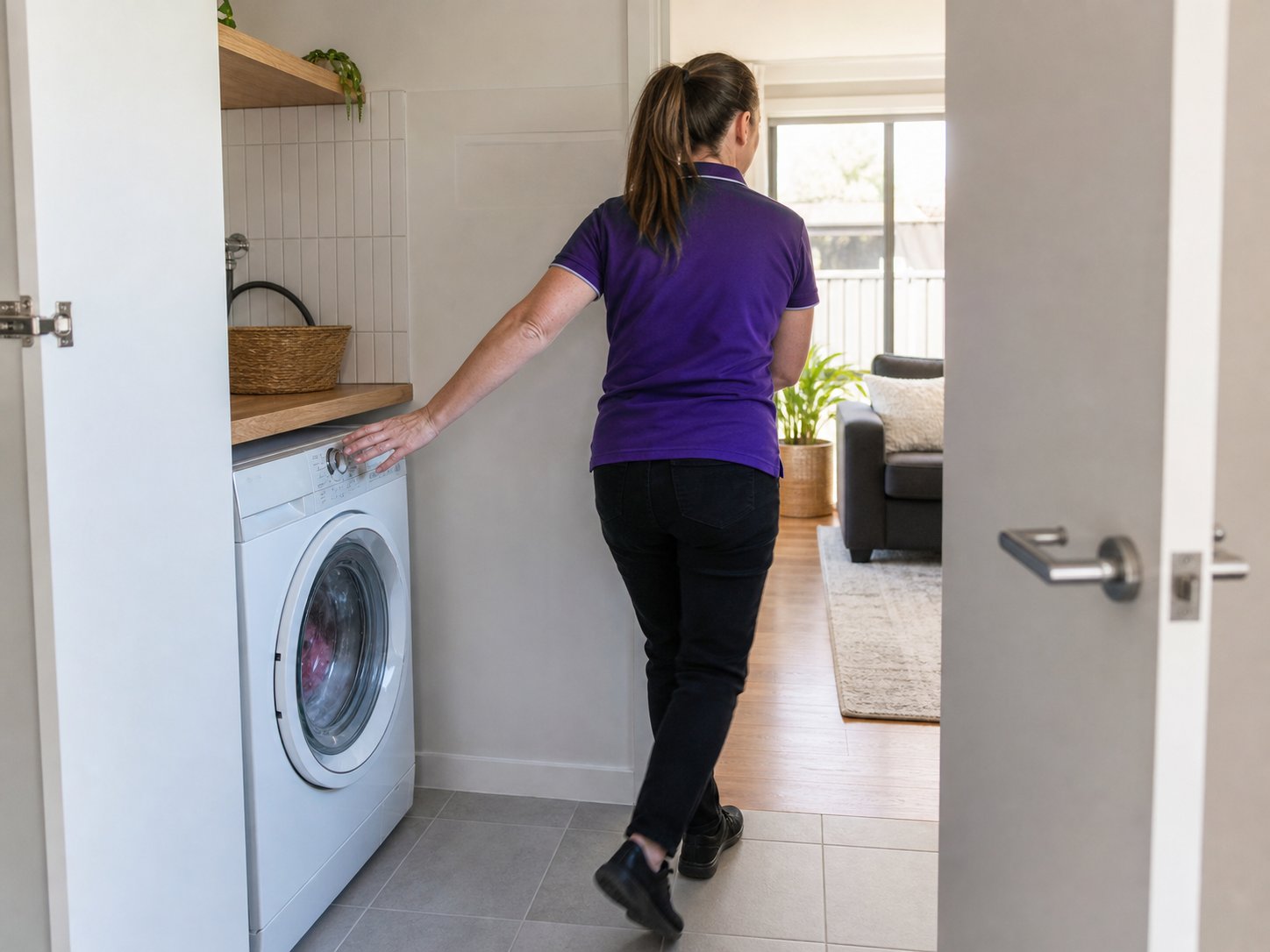
For participants with continence-related needs, laundry volume can be several times higher than a typical household — daily bedding changes, extra clothing changes, more frequent towel washing.
If disability-related continence needs result in substantially more laundry, bedding or clothing changes, explain this when discussing your support needs. The important point is how your disability affects the amount of laundry you need to manage and your ability to manage it independently.
It is also worth checking whether related supports sit elsewhere in your plan. Continence products, for example, are usually funded as consumables rather than as part of household tasks. If bedding changes are also part of your situation, see our guide to bedding and continence needs.

What NDIS laundry support usually doesn't cover
- Laundry detergent and other ordinary household consumables. These are generally everyday living expenses rather than payment for the support worker's time.
- Commercial laundry or laundromat fees. These should not be assumed to be covered simply because you receive laundry assistance. Ask your provider or NDIS contact whether a particular cost is permitted under your funding.
- Dry cleaning. Generally an ordinary household expense and should not be assumed to be NDIS-funded.
- Buying clothes or linen. Ordinary living cost.
- Laundry for other household members. Support generally needs to relate to the participant's disability-related needs rather than routine household chores for other people.
Buying or replacing a washing machine or dryer is generally a separate issue from funding a support worker to help with laundry. If you need equipment because of your disability, ask the NDIS about the appropriate assistive technology pathway.
Making laundry support work in practice
A few things that consistently make the difference:
- Be specific about what laundry help you need. Does this include folding, putting clothes away, changing bed linen or ironing? Discuss these details with your provider and include them in your service arrangements where appropriate.
- Say where things go. Most frustration with laundry support comes from clothes being folded and put in the wrong place. A one-off walkthrough with a new worker solves it.
- Sequence around the wash cycle rather than waiting on it.
- Flag anything with special handling — compression garments, adaptive clothing, delicates.
If you're looking for NDIS laundry services in Melbourne and you're in Werribee specifically, see our NDIS provider Werribee. Sahima Care Services can talk through what's realistic within your funded hours.
Common questions
Can a support worker do my laundry if I live in shared accommodation?
Yes, though the support relates to your own laundry rather than the household's. In shared settings this is usually managed by agreement about whose items are included.
Will the NDIS pay for a laundry service instead of a worker?
Usually not as a matter of course. Household task funding is structured around a worker's hourly time. Where a commercial service is genuinely the more reasonable option, it's worth raising with your plan manager or planner rather than assuming it will be accepted.
Does laundry come out of the same funding as cleaning?
Yes. Both are household tasks claimed against the same support item, drawn from your Core Supports budget. They compete for the same hours, so it's worth agreeing priorities with your worker.
Can I ask a worker to iron my clothes?
You can ask, and many will. NDIS ironing is one of the tasks that can be included, but whether it's a good use of funded time is the real question — ironing is time-intensive, and in a two-hour visit it may displace something more important.
Sources and further reading
- NDIA, NDIS Pricing Schedule 2026-27 — item 01_020_0120_1_1
- NDIA, Home, equipment and supports